
29 Jan 2026
Standing directly beneath a Boeing
787 Dreamliner inside a maintenance hangar completely changes how you see
aviation. From the terminal windows, these aircraft look massive but somehow elegant.
Up close though, actually walking around one, you start grasping just how
mind-bogglingly complex they really are—literally thousands of interconnected
systems, millions upon millions of individual components, all of which
absolutely must function perfectly together. The person ultimately responsible
for making sure this insane complexity actually works? That's the Aircraft
Maintenance Engineer. If you've ever watched planes and felt drawn not just to
the romantic idea of flight but to genuinely understanding how these machines
actually work, you're already thinking like an AME.
The aviation sector in India is
growing at a pace that would've seemed completely impossible just fifteen years
ago. New airlines keep launching. Existing carriers constantly add aircraft to
their fleets. Airports are being constructed or massively upgraded in cities
across the country. All this explosive growth creates one persistent,
consistent demand: qualified Aircraft Maintenance Engineers who can keep these
aircraft airworthy and passengers safe. But here's the part most people
miss—not just any training will get you there. The only legitimate pathway to
becoming a licensed AME runs specifically through DGCA approved colleges, and
which one you pick shapes literally your entire career trajectory for decades.
Why
DGCA Approval Is Absolutely Non-Negotiable
Let's just address the obvious thing
first. Some institutes advertise AME training without having actual DGCA
approval, often charging suspiciously low fees while making promises that sound
way too good to be real. Here's the thing—those promises are too good to be
real. Without proper DGCA approval, whatever training you receive won't be
recognized when you eventually apply for your AME license. You'll have
completely wasted multiple years of your life plus lakhs of your family's money
on training that leads absolutely nowhere professionally.
The DGCA doesn't scatter approvals
around like candy at a parade. They conduct genuinely thorough inspections of
training facilities, personally verify that colleges have adequate aircraft and
proper equipment for hands-on training, carefully scrutinize instructor
qualifications and experience, and review curriculum in detail to ensure it
actually meets current industry standards. This approval process exists for one
fundamental reason: ensuring that every single licensed AME has been trained to
a standard that makes them competent, confident, and safe to work on actual
aircraft.
Think about this from any airline's
hiring perspective for just a second. Would they seriously trust someone with
aircraft worth hundreds of crores if that person trained at some random
unapproved place? Airlines need absolute confidence that you genuinely know
what you're doing because mistakes in this field have catastrophic, deadly
consequences. DGCA approval provides that confidence. It's the baseline
credential that makes literally everything else in your AME career even
possible.
What
Real Comprehensive AME Training Actually Involves
Aircraft Maintenance Engineering
training is genuinely unlike most educational programs out there. It's not
primarily theoretical classroom learning. Yes, you absolutely need to
understand aerodynamics principles, aircraft system architecture, regulatory
requirements, and technical documentation standards. But the overwhelming bulk
of your training time gets spent actually doing things—physically performing
maintenance tasks with your own hands under careful supervision until you can
do them competently and confidently without someone watching over your
shoulder.
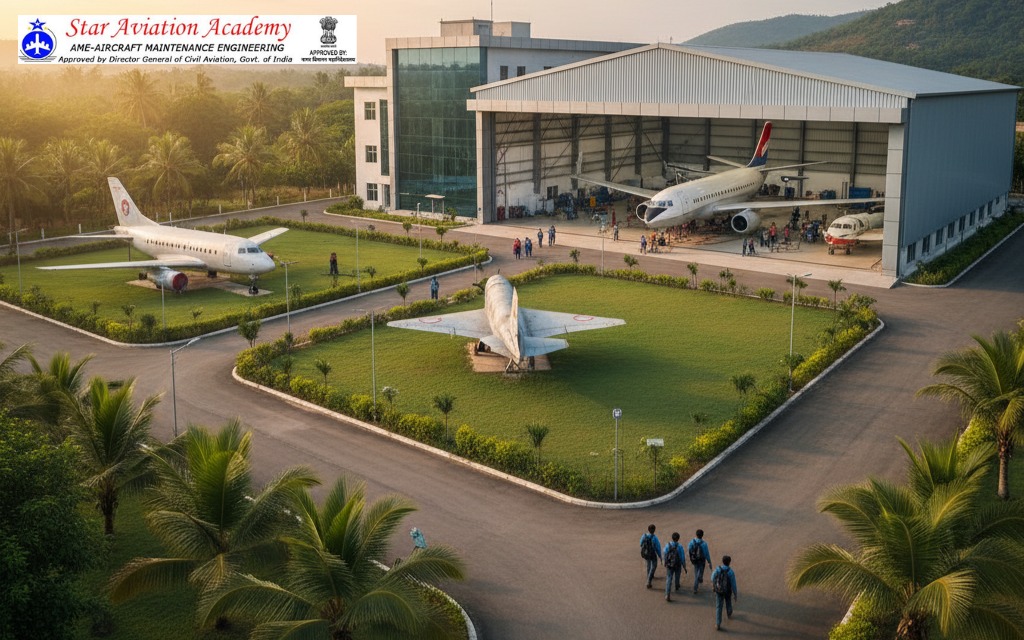
Quality DGCA approved colleges
maintain proper hangars with actual functional aircraft. Not just random old
parts or disconnected components collecting dust, but complete operational
aircraft where you practice realistic maintenance scenarios. You'll learn to
perform detailed inspections following technical manuals precisely,
troubleshoot complex faults using systematic diagnostic approaches, replace
components while maintaining absolutely meticulous documentation, and work
confidently with the specialized tools and equipment that maintenance engineers
use every single day in the field.
The curriculum typically covers
multiple technical areas depending on which specific license category you're
pursuing. For mechanical stream students, you're diving incredibly deep into
airframe structures, powerplant systems, hydraulics, pneumatics, and mechanical
systems of all types. For avionics stream students, the focus shifts heavily
toward electrical systems, navigation equipment, communication systems, flight
control computers, and all the incredibly sophisticated electronic systems that
modern aircraft depend on completely.
But technical skills alone genuinely
don't make a competent AME. You're also constantly absorbing safety culture,
learning exactly why procedures exist and why following them precisely matters,
thoroughly understanding regulatory requirements, and developing the meticulous
attention to detail and personal integrity this profession absolutely demands.
Quality training programs deliberately instill these professional values right
alongside technical competence.
Geographic
Hubs and What They Actually Offer Students
India's aviation training has
naturally concentrated in certain cities for genuinely good reasons. These specific
locations offer distinct, tangible advantages absolutely worth considering
carefully when choosing where to train.
Hyderabad's Rapidly Growing Aviation
Presence
Hyderabad has genuinely emerged as a
significant aviation hub over recent years. The city now hosts major MRO
facilities, aircraft manufacturing operations, and an increasingly busy
international airport. For students, this directly translates to real
opportunities for meaningful industry visits, actual internships, and
professional networking that simply doesn't exist in smaller cities. An AME institute in Hyderabad directly benefits from this entire ecosystem—faculty
members often maintain current industry connections, guest lecturers regularly
come from nearby aviation companies, and students get genuinely exposed to real
aviation operations on a regular basis.
The AME training landscape
throughout Hyderabad includes both government-supported and private
institutions offering different value propositions. The Rajiv Gandhi Aviation
Academy, being government-run, offers genuinely quality training at noticeably
more affordable fees compared to most private alternatives. Students
consistently appreciate the balance between reasonable cost and solid quality,
though competition for admission spots can get pretty intense. Private
institutes scattered around the city tend to have more flexible, rolling
admission processes and sometimes offer more modern, recently updated
facilities, though obviously at higher cost.
What makes Hyderabad particularly interesting
for students is the genuine diversity of aviation activity happening there.
You've got major commercial airline operations, cargo operations, helicopter
maintenance facilities, and even emerging drone-related aviation activities.
This variety naturally exposes students to broader career possibilities
extending well beyond just standard commercial airline maintenance work.
Bangalore's Unique Aviation and
Technology Convergence
Bangalore brings something genuinely
unique to the table—it's simultaneously both a major aviation hub and India's
undisputed technology capital. The various AME institute in Bangalore
options directly benefit from this interesting dual identity. The city hosts
major airline maintenance bases, several substantial MRO facilities, aerospace
manufacturing plants, and numerous aviation technology companies all clustered
relatively close together.
CAE Aviation Academy's Bangalore
facility perfectly exemplifies genuinely world-class training infrastructure.
As part of a massive global aviation training organization, they bring
international standards and proven methodologies refined over decades directly
to India. The equipment is legitimately cutting-edge and current, the training
rigorously follows best practices they've refined across their worldwide
operations, and their professional connections extend internationally beyond
just India. This obviously comes at premium pricing compared to other options,
but for students who can afford it outright or secure adequate education loans,
the investment frequently pays off through noticeably better placement
opportunities and realistic international career possibilities.
Bangalore also offers something less
tangible but equally valuable long-term—a pervasive culture of innovation and
technology throughout the entire city. The general atmosphere actively
encourages staying continuously current with emerging technological
developments, which matters increasingly in modern aircraft maintenance where
systems become progressively more computerized and software-dependent with
literally each new aircraft generation introduced.
The aviation companies clustered
throughout Bangalore mean students regularly interact directly with industry
through internships, collaborative projects, and campus recruitment drives.
Being physically present in this ecosystem naturally creates networking
opportunities that students in other locations completely miss. You might
attend an aviation industry conference, personally visit an aircraft
manufacturing facility, or directly connect with an AME currently working at a
major airline—all opportunities that emerge naturally from being in the right
geographic location at the right time.
Faculty
Quality: The Massively Overlooked Factor
Here's something that absolutely
doesn't show up in glossy marketing brochures but matters enormously to your
actual education: the massive difference between learning from someone who's
actually worked as an AME for years versus someone who only has academic
credentials but zero real industry experience. Experienced industry
professionals teaching AME training programs bring something textbooks
simply cannot provide—genuine real-world perspective earned through years of
actual work.
An instructor who spent fifteen
years maintaining Airbus aircraft at IndiGo or Boeing aircraft at Air India
knows countless things that don't appear in any manual. They know exactly which
mistakes absolute beginners always make and specific techniques to avoid them.
They understand troubleshooting approaches that come from hard-earned
experience rather than just textbook theory. They can explain not just what the
official procedure is, but why it exists in that specific form and what
actually happens when you skip steps or take shortcuts.
These experienced instructors also
naturally serve as mentors and valuable industry connections beyond just
classroom instruction. They personally know people at airlines and MRO
facilities. They understand exactly what hiring managers look for in
candidates. They can provide professional references that actually carry real
weight. When seriously researching colleges, try to learn specific details
about faculty backgrounds. How many instructors have substantial, multi-year
industry experience? How recently did they actually work in real maintenance
operations? Do they actively maintain current industry connections or are they
completely disconnected?
The
Practical Training Component That Genuinely Makes or Breaks You
No amount of classroom theory adequately
prepares you for the reality of working on an actual aircraft under intense
time pressure with real consequences for any mistakes. That's exactly why the
practical training component of your AME education matters so absolutely
critically.
DGCA mandates specific minimum hours
of practical training, but genuinely quality colleges exceed these bare
minimums significantly. You need constant repetition to develop real
competence. Performing an inspection procedure once doesn't remotely prepare
you—performing it twenty times under varying conditions with various
instructors observing and correcting your technique develops the actual skill
and confidence you genuinely need.
The best training programs
progressively increase responsibility in a structured way. Early on, you're
mostly observing and assisting qualified engineers. As you consistently
demonstrate growing competence, you gradually take on more complex tasks with
less direct supervision. By your final year, you're performing complete
maintenance procedures independently while instructors verify your work and
documentation. This carefully graduated approach builds both technical skill
and professional confidence simultaneously.
On-the-job training at actual
airline or MRO facilities represents the genuine culmination of your entire
training program. You're working on aircraft that will actually fly paying
passengers, following the exact same procedures and documentation requirements
working professionals follow, directly experiencing the real pressure and pace
of actual maintenance operations. This experience often determines how smoothly
you transition from student to working professional. Students who had quality
OJT placements typically adapt to their first real jobs much faster than those
who didn't get meaningful hands-on experience.
Understanding
the Real Financial Investment and Returns
Let's talk about money completely
honestly because it matters. DGCA approved AME training costs anywhere from 6
lakhs to 15 lakhs or potentially more for the complete program, depending
heavily on specific college, location, and license category pursued. For most
Indian families, this represents genuinely significant investment requiring
careful financial planning—whether through accumulated savings, education loans,
family support, or some combination.
This substantial investment needs to
be carefully evaluated against realistic career returns over time. Starting
salaries for newly licensed AMEs typically range from 4 to 8 lakhs annually
depending heavily on the airline, city location, and specific role assigned.
This might initially seem modest compared to the training investment, but
consider the realistic progression path. Within just 3-5 years, competent AMEs
with additional type ratings often earn 8-12 lakhs comfortably. Experienced
AMEs with multiple endorsements and senior positions regularly can earn 15-20
lakhs or substantially more. International opportunities in Gulf countries or
with foreign airlines frequently offer dramatically higher compensation packages.
The financial math works out
favorably over time, but it genuinely requires patience and continuous skill
development throughout your career. The key is ensuring your initial training
investment goes to a genuinely quality program that actually prepares you for
success rather than a cheap program that leaves you struggling to even get
licensed or perform competently once working.
Some students try aggressively
minimizing costs by choosing literally the cheapest approved college they can
possibly find. This approach sometimes works out okay, but often proves
penny-wise and pound-foolish long-term. The college with the absolute lowest
fees might have seriously outdated equipment, significantly less experienced
faculty, noticeably weaker industry connections, or substantially lower
licensing exam pass rates. Spending somewhat more upfront for genuinely better
training often pays off many times over through easier licensing success,
better first job placement, and noticeably faster career progression.
The
Licensing Journey That Follows Training
Completing your training program
doesn't automatically make you a licensed AME. You absolutely must pass DGCA
licensing examinations covering both comprehensive theoretical knowledge and
demonstrated practical skills. These exams are legitimately challenging,
testing thorough understanding and proven competence across multiple areas.
The theoretical exams cover detailed
subjects like air regulations, aviation meteorology, aircraft systems
architecture, propulsion systems, and maintenance practices. These are
detailed, genuinely technical exams requiring thorough preparation and real
understanding. Colleges with good track records deliberately structure their
curriculum to align closely with exam requirements and provide adequate
preparation time and regular mock tests.
The practical exams require
physically demonstrating specific maintenance tasks and procedures to DGCA
examiners. You need to show not just that you can mechanically perform tasks,
but that you genuinely understand what you're doing, consistently follow proper
procedures, maintain appropriate documentation, and work safely at all times.
Examiners are specifically looking for true competence and professionalism, not
just mechanical task completion.
Students from genuinely quality
training programs generally pass licensing exams at noticeably higher rates and
on earlier attempts compared to students from weaker programs. This isn't
remotely surprising—better training naturally produces better-prepared candidates.
When seriously researching colleges, try hard to find actual data on what
percentage of their graduates successfully obtain licenses and how many exam
attempts it typically takes them.
Career
Pathways Extending Beyond the Entry Level
Your first job as a newly licensed
AME is genuinely just the beginning of your career path. The career pathways
from there branch in multiple different directions based on your specific
interests, additional qualifications earned, and opportunities available.
Many AMEs deliberately specialize in
particular aircraft types, becoming recognized experts on Boeing 737s, Airbus
A320 families, or other specific models. This focused specialization
dramatically increases your value and compensation potential. Airlines
constantly need type-rated engineers and often sponsor additional training for
employees consistently showing competence and commitment.
Some AMEs progressively move toward
technical leadership—senior engineer positions, team leader roles, eventually
chief engineer or director of maintenance positions. These roles combine deep
technical expertise with increasing management responsibilities, overseeing
maintenance operations, managing engineering teams, interfacing directly with
regulatory authorities.
Others pursue quality assurance and
compliance roles, ensuring maintenance operations consistently meet DGCA and
manufacturer standards. These positions require deep technical knowledge plus
thorough understanding of regulatory requirements and quality management
systems.
Some AMEs transition into planning
and logistics functions, scheduling maintenance activities, managing critical
spare parts inventory, coordinating closely between maintenance and flight
operations departments. These roles suit people who are technically competent
but also have strong organizational and analytical skills.
International opportunities remain
genuinely open throughout your entire career. Gulf airlines consistently
recruit qualified Indian AMEs. Southeast Asian carriers, African airlines, and
aircraft leasing companies globally actively seek qualified maintenance
engineers. Working abroad for several years can provide excellent income,
diverse aircraft experience, and professional growth that benefits your career
whether you eventually return to India or pursue opportunities elsewhere
permanently.
Making
Your Decision With Eyes Wide Open
Choosing where to pursue AME
training genuinely ranks among your most consequential educational decisions.
It determines whether you successfully become licensed, how well prepared you
are for actual work, and how your early career unfolds.
Start by absolutely verifying DGCA
approval—check the official DGCA website for their current list of approved
training organizations. Only seriously consider colleges appearing on this
official list. For those colleges, dig substantially deeper. Visit campuses
physically if at all possible. Tour the actual hangars and workshops—do they
genuinely have adequate aircraft and equipment, or mostly empty space filled
with marketing materials? Talk extensively to current students away from
admission counselors—get honest, unfiltered assessments of actual training
quality, instructor competence, and placement support.
Research placement records
carefully. Where do graduates actually get hired? What realistic percentage of
each batch gets placed? How long does placement typically take after successful
licensing? Colleges sometimes significantly exaggerate placement success, so
try hard to verify claims through alumni you can contact independently.
Consider location's genuine impact
on opportunities. Training in Hyderabad, Bangalore, Delhi, Mumbai, or Chennai
provides exposure and networking opportunities literally impossible in smaller
cities. The aviation industry is surprisingly small and tightly
interconnected—being physically where things happen creates tangible
advantages.
Look carefully at faculty
qualifications and actual experience. How many instructors have substantial
industry backgrounds? Do they actively maintain current industry connections or
are they isolated? Can they provide meaningful mentorship beyond just technical
instruction?
Evaluate infrastructure completely
honestly. Are the aircraft and equipment current types actively used by
airlines, or outdated models from decades ago? Is the equipment well-maintained
and actually functional, or just sitting there for show?
Consider your specific interests and
natural strengths honestly. Do you prefer mechanical systems or electronics?
Different colleges have genuinely different strengths in B1 (mechanical) versus
B2 (avionics) training programs.
Your
Path Forward
Indian aviation's continued growth
trajectory creates genuine opportunity for qualified Aircraft Maintenance
Engineers. The demand genuinely exists, the compensation is reasonable and
improves substantially with experience, and the work itself is genuinely
interesting for people who love understanding how complex systems function.
But success absolutely isn't
automatic. It requires training from a quality DGCA approved college, passing
challenging licensing exams, developing both technical competence and
professional maturity, and continuously updating your skills as aviation
technology constantly evolves.
The investment—both time and
money—is genuinely substantial. The work demands precision, irregular hours,
and ongoing responsibility. But for people genuinely drawn to aviation and
technical problem-solving, honestly few careers offer the same combination of
stability, growth potential, and daily engagement with fascinating machinery.
Start your serious research right
now. Visit colleges, talk extensively to students and alumni, verify approvals
and claims, and make your decision based on where you'll receive the absolute
best training rather than just the cheapest or most convenient option. Quality AME classes provide the critical foundation for literally everything that
follows in your aviation career—your licensing success, your first job
placement, your professional competence, and your long-term career trajectory.
Choose that foundation extremely carefully, because you'll be building on it
for the next thirty years.
Recent Blogs